
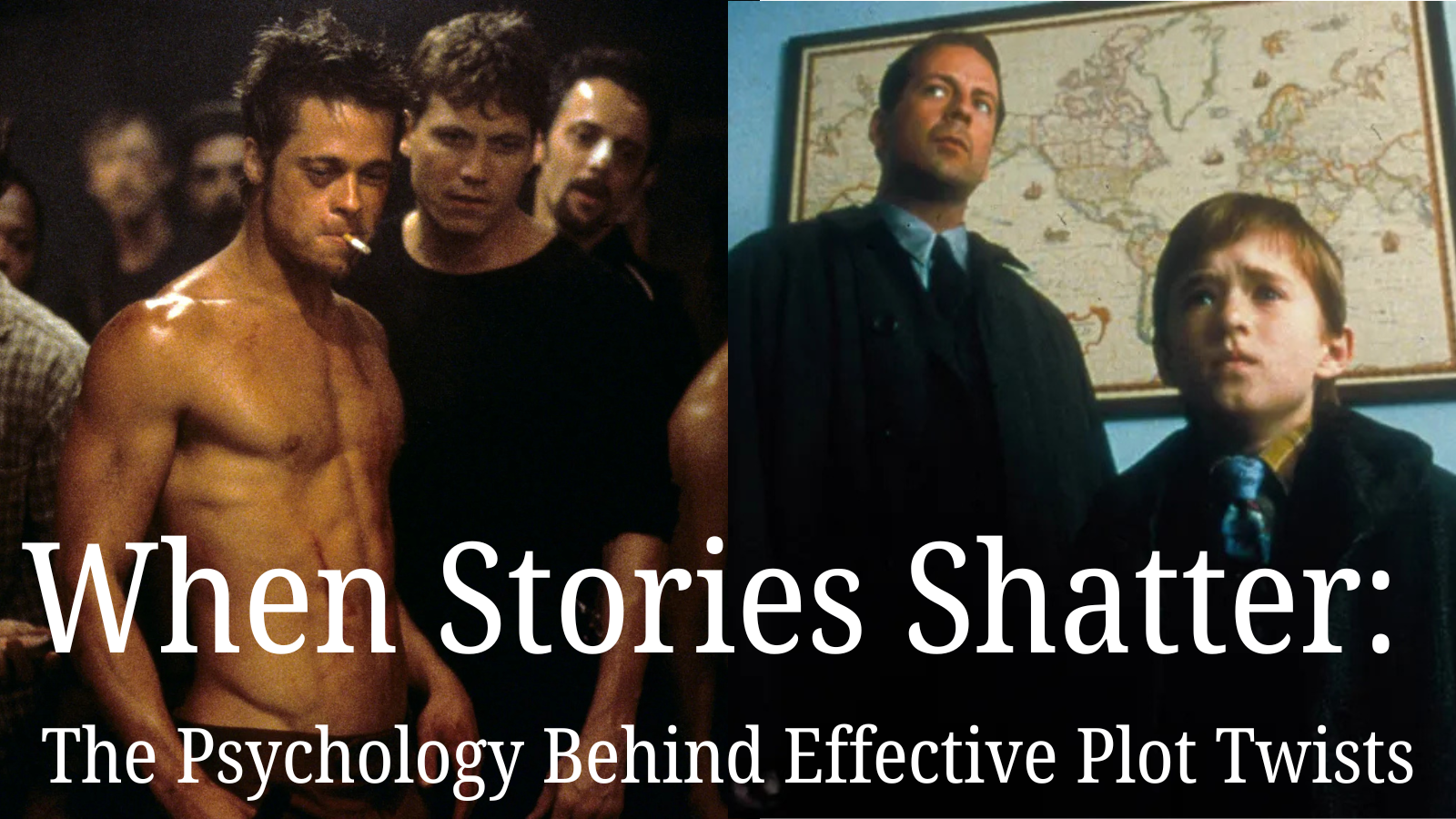
That moment when everything you thought you knew gets turned upside down. Your jaw drops, your mind races backwards through every scene, and suddenly you’re seeing an entire story through completely different eyes. We’ve all experienced the delicious shock of a well-crafted plot twist, but what’s actually happening in our brains during these revelations? And why do some twists leave us feeling satisfied whilst others feel like cheap tricks?
The psychology behind effective plot twists reveals fascinating insights about how our minds work, and these are insights that extend far beyond the cinema screen into our everyday lives.
The Prediction Machine in Your Head
Your brain is essentially a prediction machine, constantly making assumptions about what comes next based on patterns from your past experiences. Neuroscientist Andy Clark describes this as “predictive processing”. This is the idea that we’re perpetually generating hypotheses about reality, then updating them based on new information.
When you watch The Sixth Sense, your brain is busy weaving together clues: Malcolm’s troubled marriage, his determination to help Cole, the way other characters interact with him. You’re unconsciously building a coherent narrative, filling in gaps with assumptions that feel logical. This isn’t passive consumption, instead you’re actively co-creating the story.
Research by cognitive psychologist Jerome Bruner shows we naturally construct meaning through narrative frameworks. We expect stories to follow familiar patterns: heroes face obstacles, relationships develop, problems find resolution. These expectations aren’t just about entertainment. They’re fundamental to how we make sense of our world.
When Predictions Collide with Reality
The magic of The Sixth Sense‘s revelation isn’t just in the surprise, it’s in how perfectly it recontextualises everything whilst remaining absolutely consistent with what we’ve seen. Malcolm never directly interacts with anyone except Cole. His wife appears to ignore him completely. Every detail suddenly makes perfect sense from this new perspective.
This creates what psychologists call “retroactive coherence”, which is the satisfying moment when scattered puzzle pieces suddenly form a complete picture. Your brain experiences a flood of dopamine, the same neurotransmitter involved in solving problems and making discoveries. It’s literally rewarding to have your worldview successfully challenged and rebuilt.
But here’s what’s psychologically fascinating: the most effective twists don’t just surprise us. They make us feel clever for missing obvious clues that were hiding in plain sight. Research on hindsight bias shows we tend to overestimate how predictable events were after they’ve occurred. “Of course Malcolm was dead all along – the signs were everywhere!”
The Social Psychology of Unreliable Narrators
Fight Club presents a different type of psychological challenge. Here, we’re not just dealing with hidden information. Instead we’re confronting the terrifying possibility that our narrator, our guide through the story, cannot be trusted. This taps into fundamental anxieties about identity and self-knowledge.
When we discover that Tyler Durden exists only in the narrator’s fractured psyche, we’re forced to question everything we’ve witnessed. Which memories are real? How much can we trust any first-person account? This reflects genuine concerns in psychology about the reliability of human memory and perception.
Research by memory expert Elizabeth Loftus has consistently shown how easily our recollections can be influenced and distorted. We like to think of memory as a video recording, but it’s more like a constantly edited Wikipedia page where details get altered each time we access and reconstruct the experience.
Pattern Recognition and Cognitive Bias
Our vulnerability to plot twists reveals something profound about human psychology: we’re pattern-seeking creatures who can be both brilliant and blind. The confirmation bias that makes us susceptible to narrative misdirection is the same mechanism that helps us navigate daily life efficiently.
In The Sixth Sense, we notice Malcolm’s dedication to helping Cole but overlook his wife’s apparent coldness because it fits our expectations about troubled marriages. We see what confirms our existing narrative assumptions whilst filtering out contradictory evidence.
This isn’t a flaw in our thinking, it’s a feature. Without the ability to make quick assumptions based on incomplete information, we’d be paralysed by analysis. But recognising these tendencies can help us remain more open to alternative explanations, both in stories and in life.
The Neuroscience of Surprise
When a plot twist lands effectively, your brain goes through a fascinating sequence of responses. First comes the prediction error, that moment when incoming information doesn’t match your expectations. The anterior cingulate cortex lights up, signalling that something unexpected has occurred.
Next, your prefrontal cortex kicks into overdrive, working to integrate this new information with your existing understanding. You might experience a brief moment of cognitive dissonance. This is that uncomfortable feeling when holding contradictory ideas simultaneously.
Finally, if the twist provides genuine insight rather than random shock, you experience resolution. The disparate elements suddenly cohere into a new, more complete understanding. This process mirrors how we adapt to unexpected revelations in real life.
When Assumptions About People Get Challenged
Have you ever discovered something about a friend or family member that completely changed how you saw them? Perhaps learning about a secret struggle, a hidden talent, or a past experience that recontextualised their entire personality? These real-life plot twists engage the same psychological mechanisms as fictional ones.
The difference is that people are infinitely more complex than even the most sophisticated fictional characters. We all contain multitudes – contradictory desires, hidden depths, evolving identities that don’t fit neatly into any single narrative. Understanding how our minds process fictional revelations can help us approach real-life surprises with greater curiosity and less judgment.
Research on person perception shows we tend to form rapid impressions based on limited information, then struggle to update these impressions even when presented with contradictory evidence. Recognising this tendency can help us remain more open to the full complexity of the people in our lives.
The Protective Factor of Intellectual Humility
Perhaps the most valuable insight from studying plot twist psychology is the importance of intellectual humility. This is the recognition that our understanding is always provisional and incomplete. The characters who fare best in psychological thrillers are often those who remain curious rather than certain, and who ask questions rather than making assumptions.
This doesn’t mean becoming paranoid or distrustful, but rather cultivating what psychologist Carol Dweck calls a “growth mindset”, which is the belief that understanding can deepen and change over time. When we approach both stories and relationships with this openness, we’re better prepared to handle revelations without feeling devastated by them.
Embracing the Beautiful Complexity
The best plot twists don’t just shock us, they can reveal deeper truths about characters and situations. They show us that people are more complex, more contradictory, and more interesting than we initially realised. In Malcolm’s case, his death doesn’t diminish his dedication to helping Cole – it transforms it into something even more poignant.
This mirrors something profound about human psychology: we’re all carrying invisible stories, hidden struggles, and depths that might surprise even those closest to us. Everyone truly is doing their best with what they have, even when that “what they have” includes information we don’t possess.
Understanding the psychology behind plot twists can help us navigate the unexpected revelations that life inevitably brings. When someone’s behaviour suddenly makes sense in a new context, when a relationship takes an unforeseen turn, or when we discover something surprising about ourselves, we can approach these moments with curiosity rather than judgment.
After all, the most interesting stories – both fictional and real – are the ones that keep revealing new layers of meaning the deeper we look.
If you’re struggling with a real-life revelation that’s challenged your understanding of someone important to you, please consider speaking with a qualified therapist who can help you process these complex emotions in a safe, supportive environment.
What plot twist has stayed with you long after the credits rolled? How did it change the way you saw not just the story, but perhaps your own assumptions about people and relationships? Share your thoughts – these revelations often become more meaningful when we explore them together.
References
Core Research:
Clark, A. (2013). Whatever next? Predictive brains, situated agents, and the future of cognitive science. Behavioral and Brain Sciences, 36(3), 181-204.
Bruner, J. (1991). Acts of Meaning. Harvard University Press.
Loftus, E. F. (2005). Planting misinformation in the human mind: A 30-year investigation of the malleability of memory. Learning & Memory, 12(4), 361-366.
Dweck, C. S. (2006). Mindset: The New Psychology of Success. Random House.
Additional Studies:
Roese, N. J., & Vohs, K. D. (2012). Hindsight bias. Perspectives on Psychological Science, 7(5), 411-426.
Nickerson, R. S. (1998). Confirmation bias: A ubiquitous phenomenon in many guises. Review of General Psychology, 2(2), 175-220.
Shenhav, A., Cohen, J. D., & Botvinick, M. M. (2016). Dorsal anterior cingulate cortex and the value of control. Nature Neuroscience, 19(10), 1286-1291.
Krumhuber, E. G., & Hilton, D. J. (2018). How the temporal distance of past events affects impressions of their predictability. Memory & Cognition, 46(2), 274-285.
Person Perception Research:
Fiske, S. T., & Neuberg, S. L. (1990). A continuum of impression formation, from category-based to individuating processes. Advances in Experimental Social Psychology, 23, 1-74.
Uleman, J. S., Saribay, S. A., & Gonzalez, C. M. (2008). Spontaneous inferences, implicit impressions, and implicit theories. Annual Review of Psychology, 59, 329-360.
Films Referenced:
Shyamalan, M. N. (Director). (1999). The Sixth Sense [Film]. Buena Vista Pictures.
Fincher, D. (Director). (1999). Fight Club [Film]. 20th Century Fox.
Leave a Reply