
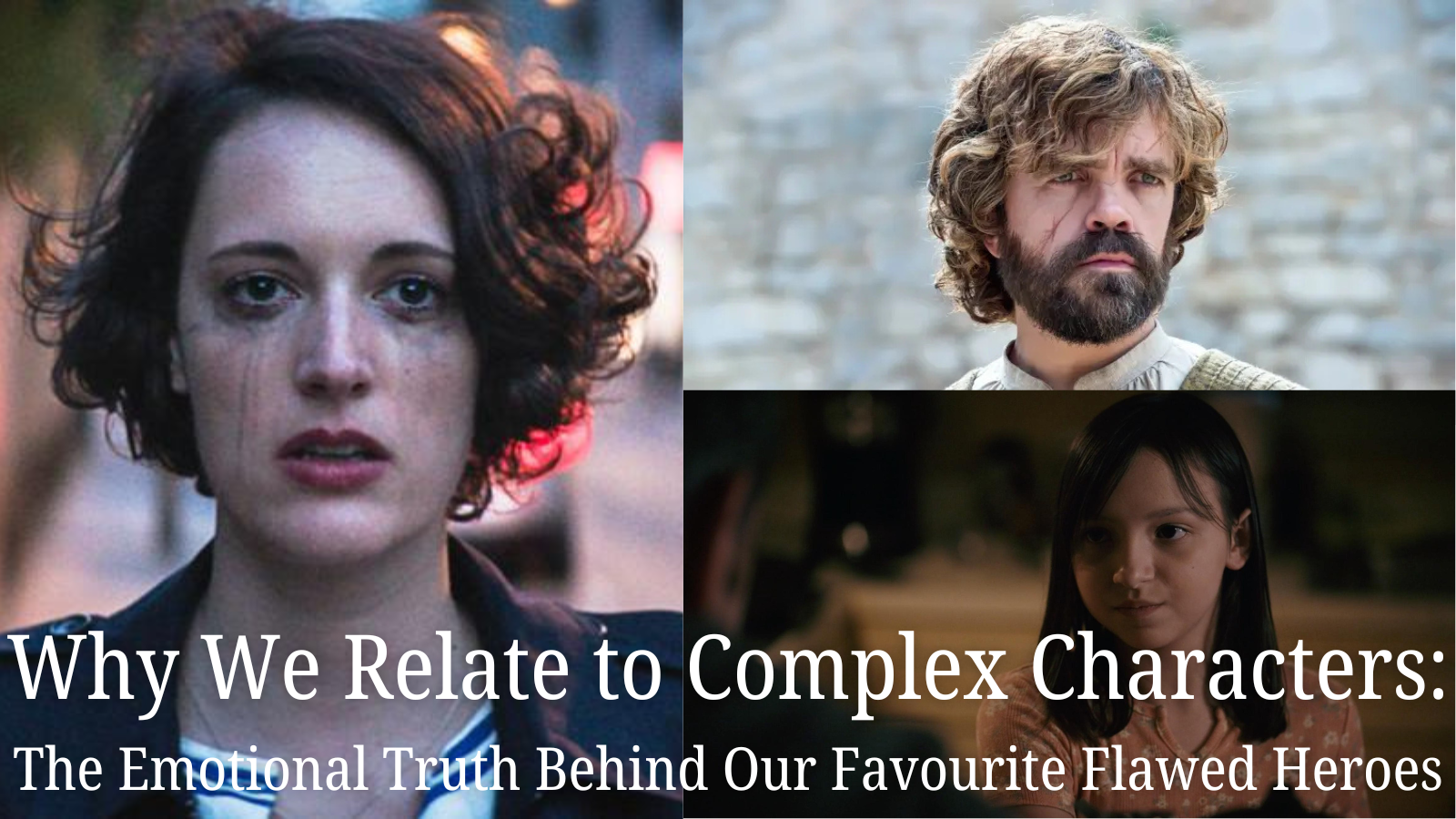
Have you ever found yourself drawn to a character who makes questionable choices? Perhaps you’ve caught yourself defending Tony Soprano’s moments of tenderness. Or feeling genuine empathy for Fleabag despite her self-destructive patterns. There’s something profoundly moving about characters who embody contradiction. Characters who are simultaneously selfish and generous, cruel and kind, broken and resilient.
What is it about complexity that makes our hearts recognise these fictional souls as real?
The Emotional Authenticity of Contradiction
The answer lies in a fundamental truth about human psychology. We are all walking contradictions. Research in emotion regulation shows that healthy adults experience an average of 3-5 different emotions simultaneously throughout their day. We might feel grateful for our job whilst simultaneously resenting certain aspects of it. We can love someone deeply and still find them irritating in specific moments. We’re capable of tremendous kindness and petty cruelty, sometimes within the same afternoon.
Yet in our daily lives, we often feel pressure to present a coherent, simplified version of ourselves. Social psychologist Dr Jennifer Aaker’s research on authenticity reveals that we frequently suppress contradictory feelings. We do this to maintain what she calls “narrative coherence.” This is the story we tell ourselves and others about who we are.
Complex characters, however, give us permission to recognise and sit with contradiction.
When we watch someone like Tyrion Lannister navigate his simultaneous love and loathing for his family, something happens. Or when we witness Jessica Jones’s fierce protectiveness existing alongside her profound emotional unavailability, something in us relaxes. These characters mirror back the messy reality of our inner lives. They reflect the parts we might otherwise feel ashamed of or struggle to understand.
The Relief of Imperfection
There’s a particular emotional relief that comes from witnessing imperfection handled with dignity. Psychologist Dr Kristin Neff’s groundbreaking work on self-compassion identifies three core components. These are self-kindness, common humanity, and mindful awareness. Complex characters often demonstrate these elements in ways that can be profoundly healing for viewers.
Consider Fleabag’s relationship with her own mistakes. Throughout the series, she maintains a kind of brutal honesty about her flaws. Yet she never completely abandons herself to despair. She embodies what Neff calls “common humanity.” This is the recognition that struggle and imperfection are part of the shared human experience. They are not personal failings that make us uniquely defective.
When we watch her navigate grief, guilt, and self-destructive impulses with moments of genuine insight and connection, we’re witnessing something important. We’re seeing a masterclass in self-compassion. Not the saccharine, “everything happens for a reason” variety. But the authentic kind that says something different. It says: “This is difficult, and I’m human, and I’m doing my best with what I have right now.”
Have you ever felt that particular relief when a character you love makes a mistake and the story doesn’t punish them eternally for it? That’s your own self-critical voice getting a gentle lesson in forgiveness.
The Mirror of Emotional Complexity
Complex characters serve as emotional mirrors. They reflect aspects of ourselves we might not otherwise examine closely. Dr Dan McAdams, whose research focuses on narrative identity, suggests something fascinating. He believes we unconsciously use stories to explore different versions of ourselves. We explore the paths we didn’t take, the choices we fear making, the aspects of our personality we haven’t fully integrated.
When we connect with a character like Walter White, we’re not necessarily endorsing his choices. But we might be exploring our own relationship with powerlessness, pride, or the fear of being overlooked. The emotional complexity of his character allows us to examine these feelings in a safe space. It’s removed from real-world consequences.
This process can be remarkably therapeutic. Research by Dr Keith Oatley at the University of Toronto demonstrates something important. Engaging with complex fictional characters actually enhances our ability to understand emotions. This includes both our own emotions and others’. The brain, it seems, doesn’t entirely distinguish between processing real and fictional emotional experiences. At least not when it comes to building empathy and emotional intelligence.
The Permission to Be Human
Perhaps most importantly, complex characters give us permission to be fully human. They model emotional honesty without requiring emotional perfection. They show us that growth isn’t about eliminating our shadows. Instead, it’s about learning to dance with them more gracefully.
Think about a character like Maya from Good Girls. She’s dealing with financial desperation, moral compromise, and the weight of providing for her family. Her choices aren’t always admirable, but they’re understandable. When we witness her internal conflict, we see something powerful. We see the genuine anguish she feels about her decisions alongside her fierce determination to protect what matters to her. We’re seeing someone grapple with impossible circumstances whilst maintaining their essential humanity.
This kind of character complexity serves as what psychologists call a “corrective emotional experience.” Instead of learning that mistakes make us irredeemably bad, we learn something different. Instead of learning that difficult emotions should be suppressed, we discover another truth. We learn that human beings can hold multiple truths simultaneously and still be worthy of love and understanding.
The Neuroscience of Connection
Fascinating research from Dr Robin Dunbar shows something remarkable. Our brains respond to well-developed fictional characters in remarkably similar ways to how they respond to real people. The neural pathways involved in empathy, theory of mind, and emotional regulation all activate when we’re deeply engaged with complex characters.
But here’s what’s particularly interesting. Characters who display emotional complexity activate these pathways more consistently than those who are entirely good or entirely villainous. It’s as if our brains recognise authentic emotional patterns and respond with deeper engagement.
This suggests that our attraction to complex characters isn’t just emotional. It’s neurological. Our brains are literally designed to connect with beings who exhibit the kind of multifaceted emotional responses that characterise real human experience.
When Characters Help Us Heal
Complex characters can also serve as models for emotional integration. They show us how different aspects of personality can coexist without destroying the whole person. This is particularly powerful for anyone who’s struggled with shame about their own contradictions.
Dr Richard Schwartz’s Internal Family Systems therapy is built on a particular premise. We all contain multiple “parts.” These are different aspects of our personality that might seem to conflict with each other. The goal isn’t to eliminate these parts, but to help them work together more harmoniously.
Complex characters often demonstrate this integration in action. They show us people who can be simultaneously strong and vulnerable, generous and self-serving, wise and foolish. They model what it looks like to be a complete person rather than a perfect one.
The Shadow Work of Storytelling
Carl Jung wrote extensively about the “shadow.” This is the aspects of ourselves we prefer not to acknowledge. He believed that psychological health required integrating these shadow aspects rather than rejecting them entirely.
Complex characters often embody this shadow work for us. They allow us to explore the parts of ourselves we might otherwise disown. Our capacity for selfishness, our potential for cruelty, our struggles with envy or fear or anger. By witnessing these qualities in characters we care about, we can begin to accept them as part of the full spectrum of human experience.
This doesn’t mean celebrating harmful behaviours. Rather, it means understanding the emotional truths that underlie them. Everyone is indeed doing their best with what they have. Even when their best includes making choices we wouldn’t want to make ourselves.
The Invitation to Wholeness
Ultimately, our connection to complex characters is an invitation to wholeness. They remind us that being human isn’t about achieving perfection. Instead, it’s about embracing the full range of our emotional experience with as much grace and self-compassion as we can muster.
They show us that redemption is possible without erasure. We can grow and change whilst still being recognisably ourselves. They demonstrate that love doesn’t require perfection, that forgiveness doesn’t require forgetting, and that healing doesn’t mean pretending our wounds never existed.
The next time you find yourself drawn to a character who makes your heart ache with recognition, pause for a moment. What part of your own beautiful, complicated humanity are they reflecting back to you? What permission are they giving you to be more fully yourself?
In a world that often demands we present simplified versions of ourselves, complex characters are a radical act of truth-telling. They insist that all of us deserve to be seen, understood, and loved in our entirety. Both fictional and real.
Because everyone, indeed, is doing their best with what they have. And sometimes, that’s beautifully, messily, perfectly enough.
If you’re struggling with self-acceptance or finding it difficult to extend compassion to yourself, please consider speaking with a qualified mental health professional. The insights we gain from stories can complement, but never replace, appropriate therapeutic support.
What complex character has helped you understand yourself better? I’d love to hear your thoughts in the comments below.
References and Citations
Aaker, J. L. (2000). Accessibility or diagnosticity? Disentangling the influence of culture on persuasion processes and attitudes. Journal of Consumer Research, 26(4), 340-357.
Dunbar, R. I. M. (2004). The human story: A new history of mankind’s evolution. London: Faber & Faber.
Dunbar, R. I. M. (2012). On the evolutionary function of song and dance. In N. Bannan (Ed.), Music, language, and human evolution (pp. 201-214). Oxford University Press.
Jung, C. G. (1969). The archetypes and the collective unconscious (2nd ed., R. F. C. Hull, Trans.). Princeton University Press. (Original work published 1959)
McAdams, D. P. (2011). The stories we live by: Personal myths and the making of the self (2nd ed.). Guilford Press.
McAdams, D. P. (2008). Personal narratives and the life story. In O. P. John, R. W. Robins, & L. A. Pervin (Eds.), Handbook of personality: Theory and research (3rd ed., pp. 242-262). Guilford Press.
Neff, K. D. (2003). Self-compassion: An alternative conceptualization of a healthy attitude toward oneself. Self and Identity, 2(2), 85-101.
Neff, K. D. (2011). Self-compassion: The proven power of being kind to yourself. William Morrow.
Oatley, K. (2011). Such stuff as dreams: The psychology of fiction. Wiley-Blackwell.
Oatley, K. (2016). Fiction: Simulation of social worlds. Trends in Cognitive Sciences, 20(8), 618-628.
Schwartz, R. C. (1995). Internal family systems. Guilford Press.
Schwartz, R. C. (2021). No bad parts: Healing trauma and restoring wholeness with the Internal Family Systems model. Sounds True.
Further Reading
“The Gifts of Imperfection” by Brené Brown
A compassionate exploration of vulnerability, shame, and the courage to embrace our authentic selves. Brown’s research-backed insights complement the themes of accepting complexity in both ourselves and the characters we love.
“Man and His Symbols” by Carl Jung
Jung’s accessible introduction to his psychological theories, including the concept of the shadow self. Essential reading for understanding how we project aspects of ourselves onto fictional characters and why this process can be so healing.
“The Uses of Enchantment” by Bruno Bettelheim
Though focused on fairy tales, Bettelheim’s analysis of how stories help us process psychological conflicts applies beautifully to our relationship with complex characters in contemporary media.
“The Happiness Hypothesis” by Jonathan Haidt
Haidt’s exploration of human psychology includes fascinating insights into moral complexity and why we’re drawn to characters who embody contradictions. Particularly relevant for understanding our emotional responses to morally ambiguous figures.
“Self-Compassion: The Proven Power of Being Kind to Yourself” by Kristin Neff
The definitive guide to developing self-compassion, which directly relates to how we can extend the same understanding we feel for complex characters to ourselves in our daily lives.
Leave a Reply