
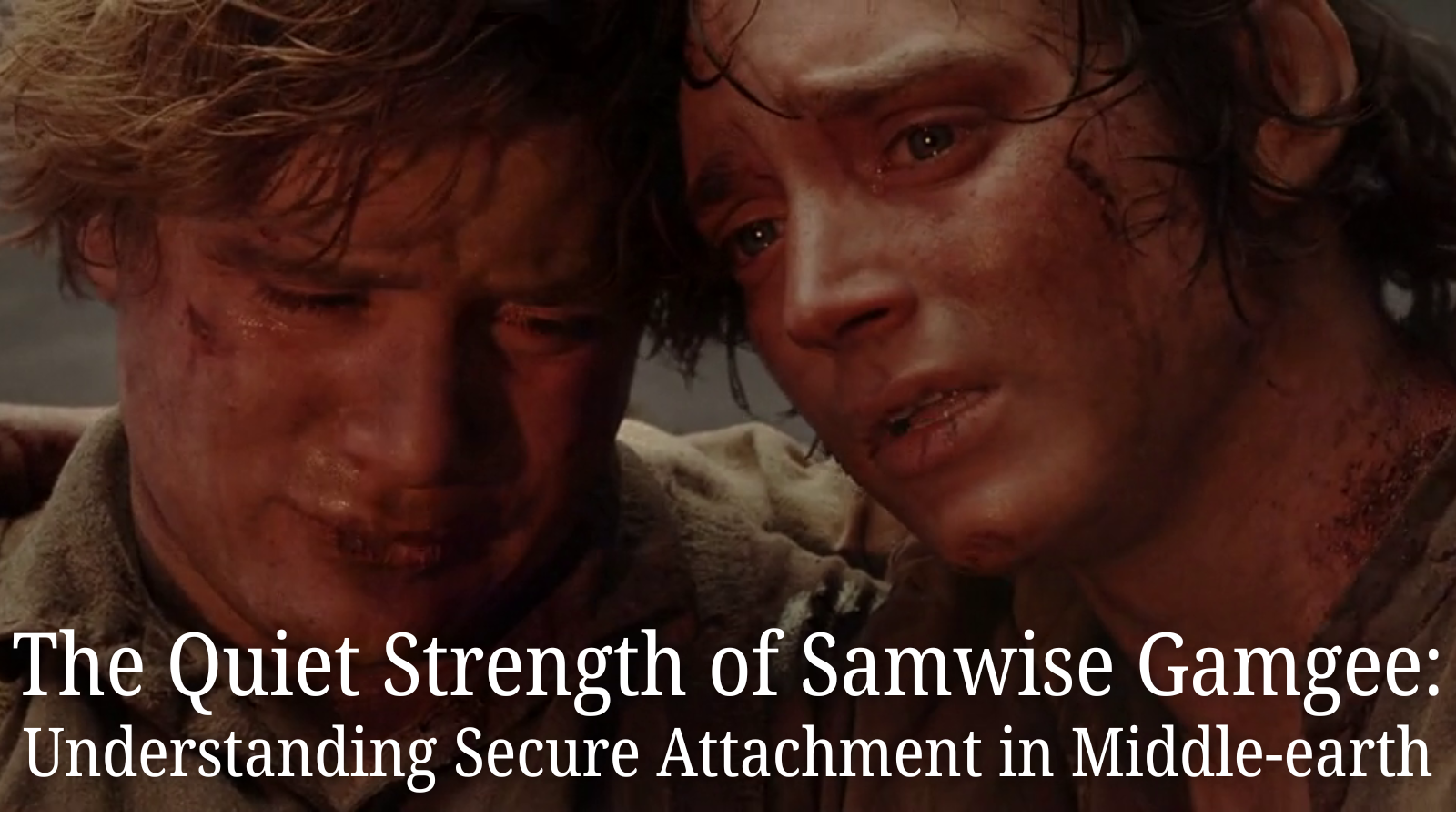
There’s a moment in The Two Towers when Frodo, consumed by the Ring’s influence, points Sting at Sam’s throat. Watch Sam’s face carefully in this scene. There’s hurt, yes, but no fear, no anger, no defensive withdrawal. Instead, there’s something remarkable: an unshakeable belief in who Frodo truly is, even when Frodo has momentarily lost sight of it himself.
This moment shows us something psychologically profound about Samwise Gamgee that makes him one of cinema’s most powerful examples of secure attachment in action. Sam doesn’t just love Frodo. He holds him, psychologically speaking, in a way that transforms both characters and offers us a masterclass in what it means to be a secure base for another human being.
What Secure Attachment Actually Looks Like
When psychologist John Bowlby first developed attachment theory in the 1960s, he identified a fundamental human need: the requirement for a secure base from which to explore the world. Later research by Mary Ainsworth revealed that securely attached individuals possess a remarkable ability. They can provide this same security to others, becoming what researchers call a “safe haven” during times of distress.
Sam embodies this perfectly. Throughout the trilogy, he demonstrates the four key characteristics of secure attachment: emotional regulation, consistent availability, attunement to others’ needs, and an unshakeable belief in the fundamental goodness of his attachment figure, even when that person struggles to see it in themselves.
But what makes Sam’s psychological presentation so fascinating is how his secure attachment manifests not in dramatic gestures, but in quiet, consistent presence.
The Psychology of Consistent Availability
Research consistently shows that secure attachment isn’t built through grand romantic gestures or dramatic rescues. It’s forged through what psychologists call “consistent responsiveness.” Sam understands this intuitively.
Watch how he responds when Frodo wakes from nightmares throughout their journey. There’s no dramatic fussing, no overwhelming concern that might make Frodo feel more vulnerable. Instead, Sam offers what attachment researchers call “optimal responsiveness.” He’s present, calm, and attuned to exactly what Frodo needs in that moment. Sometimes it’s gentle conversation about the Shire. Sometimes it’s simply sitting quietly nearby. Sometimes it’s practical care: sharing food, tending to wounds, keeping watch.
This isn’t coincidental. Secure attachment figures have an almost uncanny ability to read emotional cues and respond appropriately. When Frodo becomes withdrawn and suspicious under the Ring’s influence, Sam doesn’t take it personally or respond with hurt feelings. Instead, he recognises it as a sign that Frodo needs even more consistent support, not less.
Have you ever had someone in your life who could do this? Someone who remained steady and present even when you were at your most difficult? If so, you’ll recognise the profound psychological safety Sam creates for Frodo.
Emotional Regulation as a Gift
One of the most psychologically interesting aspects of Sam’s character is his remarkable emotional regulation. This isn’t about suppressing feelings. Sam cries, grieves, feels fear and frustration. Rather, it’s about his ability to experience emotions without being overwhelmed by them, and more importantly, without his emotional state making Frodo feel worse.
Consider the scene at the Forbidden Pool, where Sam watches Sméagol catch fish. Sam’s disgust and suspicion are clear, but he doesn’t let these feelings drive his behaviour. He maintains his protective stance without escalating conflict unnecessarily. This is emotional regulation in service of attachment. Sam’s ability to manage his own internal state creates space for Frodo to process his complex feelings about Sméagol without additional pressure.
Attachment research tells us that this kind of emotional regulation is often learned in childhood through having our own emotions consistently acknowledged and soothed. While we don’t see Sam’s early life in the films, his secure attachment style suggests he likely experienced this kind of consistent emotional attunement growing up in the Shire.
More importantly, Sam now provides this same gift to Frodo. Psychologists call this “co-regulation.” When Frodo becomes dysregulated (anxious, withdrawn, aggressive), Sam’s calm presence helps regulate Frodo’s nervous system. It’s not that Sam fixes Frodo’s emotions, but rather that his consistent, regulated presence creates a safe space where Frodo’s emotions can settle naturally.
The Power of Unconditional Positive Regard
Perhaps the most remarkable aspect of Sam’s psychological presentation is his demonstration of what psychologist Carl Rogers called “unconditional positive regard.” This is the ability to maintain deep respect and care for someone regardless of their behaviour or emotional state.
This reaches its peak during Frodo’s darkest moments. When Frodo tells Sam to leave at the end of The Two Towers, Sam’s response is extraordinary: “I made a promise, Mr. Frodo. A promise. Don’t you leave him, Samwise Gamgee. And I don’t mean to.”
What’s psychologically significant here isn’t just Sam’s loyalty. It’s his ability to see beyond Frodo’s current state to his essential self. Secure attachment figures possess this remarkable capacity to hold onto their understanding of who someone truly is, even when that person temporarily loses sight of it themselves.
This isn’t naive optimism. Sam clearly sees Frodo’s suffering, his growing darkness, his moments of cruelty. But he also understands something crucial that attachment research has consistently demonstrated: people struggling with trauma or overwhelming stress often push away the very support they most need. Sam’s unconditional positive regard allows him to weather these storms without withdrawing his support.
Think about times in your own life when someone maintained belief in you when you couldn’t believe in yourself. This is the psychological gift Sam offers Frodo. A kind of external holding of hope until Frodo can hold it again himself.
Attunement Without Enmeshment
One of the most sophisticated aspects of Sam’s secure attachment is his ability to be deeply attuned to Frodo’s needs without losing his own sense of self. Psychologists call this maintaining healthy boundaries while remaining emotionally available.
Throughout their journey, Sam demonstrates remarkable attunement. He knows when Frodo needs space and when he needs connection. He recognises the signs of the Ring’s influence before Frodo does. He understands when gentle humour might lift Frodo’s spirits and when quiet presence is more appropriate.
But crucially, Sam maintains his own identity throughout this process. He doesn’t become consumed by Frodo’s emotional state or try to fix him. Instead, he offers what secure attachment figures do best: a consistent, safe presence that allows the other person to process their own experiences.
This balance (being deeply caring without becoming enmeshed) is one of the hallmarks of secure attachment. Sam cares profoundly about Frodo’s wellbeing, but he doesn’t make Frodo’s emotional state his responsibility to control or manage.
The Neuroscience of Safety
Modern neuroscience research helps us understand why Sam’s presence is so transformative for Frodo. When we feel genuinely safe with another person (when we experience what researchers call “felt safety”), our nervous system can shift out of survival mode and into a state where healing and growth become possible.
Sam creates this felt safety through consistent, predictable behaviour. Frodo never has to guess where he stands with Sam or whether Sam will be there when needed. This predictability allows Frodo’s nervous system to gradually trust that he’s not facing his challenges alone.
The physical manifestation of this is visible throughout the films. Watch Frodo’s posture and facial expressions when Sam is near versus when he’s separated from Sam. With Sam present, even in moments of great difficulty, there’s a subtle relaxation in Frodo’s body language. This is the physical expression of feeling genuinely supported.
This isn’t just comfort. It’s the neurobiological foundation that makes resilience possible. When our nervous system feels safe, we can access higher-order thinking, emotional processing, and problem-solving abilities that become unavailable when we’re in survival mode.
The Ripple Effects of Secure Attachment
What makes Sam’s character so psychologically rich is how his secure attachment style influences not just Frodo, but everyone around him. Throughout the trilogy, we see other characters drawn to Sam’s steady presence, from his interactions with Faramir to his gentle handling of Sméagol.
This reflects real-world research on secure attachment. People with secure attachment styles tend to bring out the best in others, creating what psychologists call “earned security.” This is the possibility for people with less secure attachment histories to develop more secure patterns through relationship.
We see hints of this with Frodo himself. While Frodo clearly struggles with the trauma of bearing the Ring, his fundamental capacity for trust and connection suggests he likely had secure early attachments. His ability to accept Sam’s support, even in his darkest moments, demonstrates the psychological flexibility that comes from having experienced secure relationships.
Lessons in Being a Secure Base
Sam’s character offers profound insights into what it means to be a secure base for others in our own lives. His approach demonstrates several key principles:
Consistency over intensity. Sam’s support isn’t dramatic or overwhelming. It’s steady and reliable. This consistency creates the safety that allows real healing and growth to occur.
Presence over solutions. Sam rarely tries to fix Frodo’s problems or talk him out of his difficulties. Instead, he offers companionship through the struggle, trusting in Frodo’s own capacity for resilience.
Attunement over assumption. Sam pays careful attention to what Frodo actually needs rather than assuming he knows what would be helpful. This requires ongoing attention and emotional intelligence.
Boundaries with compassion. Sam maintains his own wellbeing and identity while being deeply supportive. This balance prevents the relationship from becoming codependent while maximising its healing potential.
The question for all of us becomes: how might we cultivate these qualities in ourselves? How might we become more like Sam? Steady, present, and unshakeably believing in the fundamental goodness of the people we care about?
The Ultimate Expression of Love
In the end, what makes Sam’s character so moving isn’t just his loyalty. It’s his demonstration of what love looks like when it’s rooted in secure attachment. Sam’s love for Frodo doesn’t demand reciprocity or recognition. It doesn’t waver when things become difficult or when Frodo is unable to return it fully.
Instead, Sam’s love is what attachment researchers call “caregiving without expectation.” This is the ability to provide support simply because someone needs it, without requiring anything in return. This is perhaps the highest expression of secure attachment: love that creates safety and space for the other person to be fully themselves, even when that self is struggling or in pain.
When Frodo finally boards the ship to the Undying Lands, Sam’s grief is profound but not bitter. He understands that sometimes loving someone means letting them go where they need to go for their own healing. This, too, is secure attachment. The ability to prioritise the other person’s wellbeing even when it means personal loss.
Everyone Is Doing Their Best
Throughout their journey, Sam embodies the fundamental principle that everyone is doing their best with what they have. He sees Frodo’s struggles not as character flaws but as the natural response to an impossible burden. He recognises that Sméagol’s corruption stems from his own trauma and loss. Even in moments of conflict or disappointment, Sam maintains his basic faith in people’s fundamental goodness.
This perspective (that everyone is doing their best with their current resources and circumstances) is both a cornerstone of secure attachment and a radical act of compassion. It allows Sam to respond to others’ difficulties with curiosity and care rather than judgement or rejection.
Perhaps this is Sam’s greatest gift to us as viewers: the reminder that this kind of steady, unconditional love is possible. That we can choose to be people who create safety for others, who believe in their fundamental goodness even when they struggle to see it themselves, and who offer the consistent presence that makes healing and growth possible.
In a world that often feels chaotic and disconnected, Sam reminds us that being someone’s secure base (being truly, consistently there for another person) might be one of the most important things we can do.
If you’re recognising patterns from your own relationships in this analysis (whether you’re someone who provides secure attachment for others or someone who would benefit from more secure relationships), remember that attachment patterns can change throughout our lives. Professional support can be incredibly valuable for exploring these dynamics further.
References and Citations
- Ainsworth, M. D. S., Blehar, M. C., Waters, E., & Wall, S. (1978). Patterns of attachment: A psychological study of the strange situation. Lawrence Erlbaum.
- Bowlby, J. (1988). A secure base: Parent-child attachment and healthy human development. Basic Books.
- Hazan, C., & Shaver, P. (1987). Romantic love conceptualized as an attachment process. Journal of Personality and Social Psychology, 52(3), 511-524.
- Main, M. (1996). Introduction to the special section on attachment and psychopathology: 2. Overview of the field of attachment. Journal of Consulting and Clinical Psychology, 64(2), 237-243.
- Porges, S. W. (2011). The polyvagal theory: Neurophysiological foundations of emotions, attachment, communication, and self-regulation. W. W. Norton & Company.
- Rogers, C. R. (1957). The necessary and sufficient conditions of therapeutic personality change. Journal of Consulting Psychology, 21(2), 95-103.
- Shonkoff, J. P., & Phillips, D. A. (Eds.). (2000). From neurons to neighborhoods: The science of early childhood development. National Academy Press.
Further Reading
- “Attached: The New Science of Adult Attachment” by Amir Levine and Rachel Heller – An accessible exploration of how attachment styles manifest in adult relationships, with practical insights for developing more secure connections.
- “The Body Keeps the Score” by Bessel van der Kolk – Essential reading for understanding how trauma affects our capacity for connection and how healing relationships can help restore our sense of safety.
- “Wired for Love” by Stan Tatkin – A neuroscience-based approach to understanding how we can become secure bases for our partners and loved ones.
- “Hold Me Tight” by Sue Johnson – Focuses specifically on how attachment theory applies to intimate relationships and how we can create more secure emotional bonds.
- “The Power of Showing Up” by Daniel Siegel and Tina Payne Bryson – Explores the four pillars of attachment (safety, seen, soothed, and secure) and how we can provide these experiences for others in our lives.
Leave a Reply