
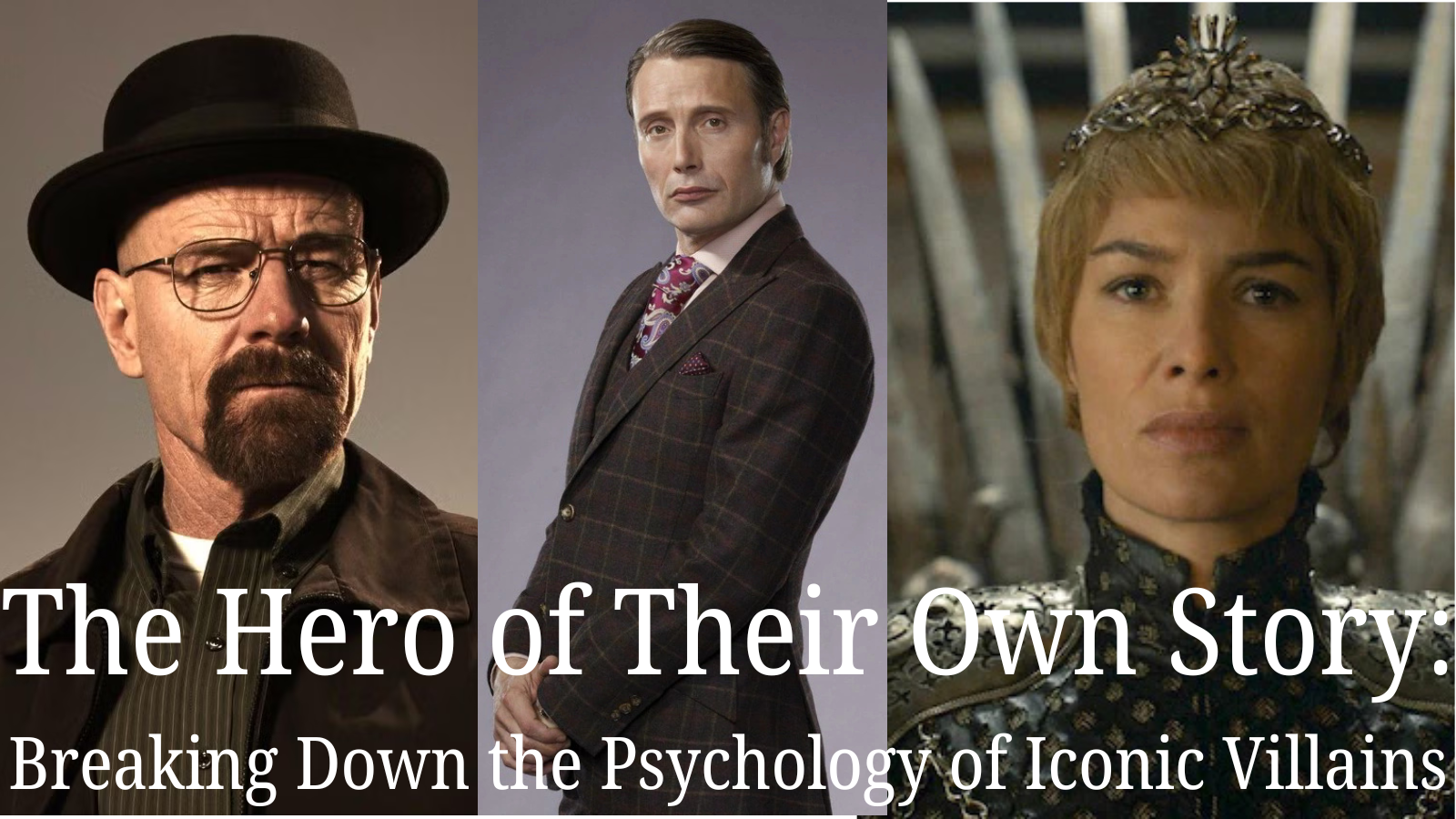
Content note: This piece explores complex psychological themes including trauma, manipulation, and harmful behaviours. It’s intended for educational purposes and doesn’t constitute professional advice. If you’re struggling with similar experiences, please consider speaking with a qualified mental health professional.
What if I told you that Hannibal Lecter sees himself as an artist? That Walter White genuinely believes he’s a devoted family man? That even Voldemort operates from a twisted but internally consistent moral framework?
Here’s the uncomfortable truth about human psychology: we’re all remarkably skilled at casting ourselves as the hero of our own stories. Even when our actions cause tremendous harm, our minds work overtime to maintain the narrative that we’re fundamentally good people doing necessary things. This isn’t a character flaw unique to fictional villains. It’s a universal feature of human cognition that becomes fascinating, and frightening, when taken to extremes.
Let’s explore how three iconic antagonists demonstrate this psychological phenomenon. We’ll see what their internal narratives reveal about the beautiful, complex, sometimes disturbing ways we all construct meaning from our choices.
Walter White: The Provider’s Delusion
“I did it for my family.”
Walter White’s transformation from mild-mannered chemistry teacher to methamphetamine kingpin is perhaps one of the most compelling character arcs in television. What makes Walter so unsettling isn’t his descent into criminality. It’s how convincingly he maintains his self-image as a devoted family man throughout.
From a psychological perspective, Walter demonstrates several fascinating cognitive mechanisms working in tandem. Moral disengagement theory, developed by Albert Bandura, explains how people convince themselves that ethical standards don’t apply to their behaviour. Walter employs nearly every mechanism Bandura identified. He euphemistically labels his drug manufacturing as “providing for his family.” He displaces responsibility onto circumstances (“I had no choice”). And he dehumanises his victims (they’re “in the game”).
But there’s something deeper happening here. Walter’s narrative isn’t just self-serving. It’s rooted in genuinely held values about masculinity, provision, and legacy. Research on threatened masculinity shows that when men feel their provider role is compromised, they often compensate through behaviours that restore their sense of dominance and control. Walter’s cancer diagnosis and financial struggles represent a profound threat to his identity as protector and provider.
What’s psychologically fascinating is how Walter’s brain protects his self-concept by reframing increasingly heinous acts as expressions of love. This isn’t conscious manipulation. It’s the mind’s sophisticated defence system working to maintain psychological coherence. The alternative would be accepting that he’s chosen power and pride over his family’s wellbeing. This would create unbearable cognitive dissonance.
Notice how Walter never sees himself as the villain disrupting his family’s peace. In his narrative, he’s the hero sacrificing everything to secure their future. The fact that his actions ultimately destroy his family doesn’t penetrate this protective psychological framework until the very end.
Hannibal Lecter: The Aesthete’s Philosophy
“I prefer to eat the rude.”
Hannibal Lecter operates from perhaps the most sophisticated moral framework of any fictional villain. He doesn’t see himself as a monster. He sees himself as a connoisseur of human experience, an artist whose medium happens to be murder and consumption.
Hannibal’s psychology reveals the dark side of aesthetic moral reasoning. This is the idea that beauty, elegance, and refinement can become ethical principles in themselves. Research on moral foundations theory suggests that humans can construct moral systems around various values: care, fairness, loyalty, authority, sanctity, and indeed, beauty. Hannibal has built his entire ethical framework around aesthetic principles. He views rudeness, poor taste, and vulgarity as sins worthy of death.
This isn’t arbitrary cruelty. It’s a coherent (if deeply disturbed) philosophical system. Hannibal genuinely believes he’s improving the world by removing those who lack refinement, grace, or intellectual curiosity. In his mind, he’s not a predator but a curator, carefully selecting those whose absence will elevate the overall quality of human experience.
The psychological sophistication here is remarkable. Hannibal demonstrates what researchers call intellectualisation. This is a defence mechanism where emotional conflicts are dealt with through excessive abstract thinking. His elaborate philosophical justifications serve to distance him from the emotional reality of his actions whilst maintaining his self-image as a cultured, enlightened individual.
What makes Hannibal particularly chilling is his genuine appreciation for beauty, art, and human connection. He’s not a psychopath devoid of emotional capacity. He’s someone who has channelled natural human tendencies toward aesthetic appreciation and social hierarchy into a murderous worldview. He forms real attachments (particularly to Will Graham) and experiences genuine emotions, but always filtered through his aesthetic moral framework.
In Hannibal’s narrative, he’s not the villain. He’s the refined host cleaning up a world plagued by poor manners and mediocre thinking. His actions aren’t evil; they’re necessary maintenance of cultural standards.
Cersei Lannister: The Mother’s Justified Fury
“Everyone who isn’t us is an enemy.”
Cersei Lannister might be the most psychologically complex example of self-justifying villainy because her motivations spring from such a fundamentally human source: maternal love and protection.
Cersei’s psychology is deeply shaped by attachment theory and maternal threat response. Research consistently shows that perceived threats to offspring trigger some of the most powerful psychological and physiological responses humans are capable of. Cersei operates in a constant state of hypervigilance, interpreting nearly every political move as a potential danger to her children.
But here’s where it gets psychologically interesting: Cersei’s protective responses are amplified by her own childhood trauma and the rigid gender expectations of her world. Studies on intergenerational trauma reveal how parents who experienced powerlessness in childhood often overcompensate by seeking excessive control over their children’s environment. Cersei’s father’s dismissive treatment, combined with the restricted agency available to women in Westeros, creates a psychological perfect storm.
From Cersei’s perspective, she’s not a power-hungry queen destroying lives for personal gain. She’s a mother doing whatever is necessary to protect her cubs in a hostile world. Every manipulation, every execution, every act of cruelty is reframed as maternal duty. The psychological mechanism at work here is moral elevation through protective motivation. This is the way our brains transform questionable actions into virtuous ones when we frame them as protecting those we love.
What’s particularly fascinating about Cersei is how her genuine love for her children becomes psychologically indistinguishable from her need for control and power. She can’t separate protecting her family from eliminating anyone who might challenge her authority, because in her worldview, these are the same thing. The prophecy about her children’s deaths intensifies this psychological fusion, turning every political rival into an existential threat to her babies.
Cersei demonstrates how catastrophic thinking and all-or-nothing reasoning can transform normal parental protectiveness into destructive extremism. In her mind, any threat to her power is a threat to her children’s survival, justifying increasingly desperate and harmful responses.
The Universal Psychology of Self-Justification
What makes these characters so compelling is how recognisable their psychological patterns are. What makes them so disturbing is the same thing. We all engage in moral disengagement when our behaviour doesn’t align with our values. We all construct narratives that cast us as the hero of our own story. We all have moments where our protective instincts or threatened identities push us toward choices we might later question.
The difference isn’t necessarily in the psychological mechanisms. It’s in the degree, the context, and crucially, the presence or absence of corrective feedback from our environment and relationships.
Research on moral licensing shows that when we see ourselves as good people, we often give ourselves permission to act in ways that contradict that self-image, secure in the knowledge that we’re fundamentally ethical. Walter’s years as a devoted teacher “licence” his criminal behaviour. Hannibal’s cultural refinement “justifies” his murders. Cersei’s maternal love “excuses” her cruelty.
Perhaps the most unsettling insight from villain psychology is this: the capacity for self-deception that allows these characters to commit terrible acts whilst maintaining positive self-regard isn’t pathological. It’s deeply, recognisably human. We’re all walking around with sophisticated psychological defence systems designed to protect our self-concept. Under the right circumstances, those same systems that help us cope with everyday moral complexities can enable genuinely harmful behaviour.
The stories we tell ourselves about our motivations, our circumstances, and our choices have tremendous power to shape not just how we feel about our actions, but what actions we’re capable of taking in the first place. Understanding this doesn’t excuse harmful behaviour, but it does illuminate something profound about human nature: we’re all the hero of our own story, even when we’re playing the villain in someone else’s.
The exploration of villain psychology reminds us that human behaviour exists on a spectrum, and that understanding the psychological mechanisms behind harmful actions can help us recognise and address these patterns in ourselves and our communities. Everyone truly is doing their best with what they have, even when that “best” falls far short of what the world needs from them.
References
Moral Disengagement and Self-Justification:
- Bandura, A. (2016). Moral Disengagement: How People Do Harm and Live with Themselves. Worth Publishers.
- Bandura, A. (1999). Moral disengagement in the perpetration of inhumanities. Personality and Social Psychology Review, 3(3), 193-209.
Threatened Masculinity and Provider Identity:
- Vandello, J. A., Bosson, J. K., Cohen, D., Burnaford, R. M., & Weaver, J. R. (2008). Precarious manhood. Journal of Personality and Social Psychology, 95(6), 1325-1339.
- Willer, R., Rogalin, C. L., Conlon, B., & Wojnowicz, M. T. (2013). Overdoing gender: A test of the masculine overcompensation thesis. American Journal of Sociology, 118(4), 980-1022.
Moral Foundations and Aesthetic Reasoning:
- Haidt, J. (2012). The Righteous Mind: Why Good People Are Divided by Politics and Religion. Vintage Books.
- Graham, J., Nosek, B. A., Haidt, J., Iyer, R., Koleva, S., & Ditto, P. H. (2011). Mapping the moral domain. Journal of Personality and Social Psychology, 101(2), 366-385.
Defence Mechanisms and Intellectualisation:
- Vaillant, G. E. (1992). Ego Mechanisms of Defense: A Guide for Clinicians and Researchers. American Psychiatric Press.
- Perry, J. C. (1990). Defense Mechanism Rating Scales (DMRS). Cambridge Health Alliance.
Attachment Theory and Maternal Protection:
- Bowlby, J. (1988). A Secure Base: Parent-Child Attachment and Healthy Human Development. Basic Books.
- Hrdy, S. B. (1999). Mother Nature: Maternal Instincts and How They Shape the Human Species. Ballantine Books.
Intergenerational Trauma:
- Van der Kolk, B. A. (2014). The Body Keeps the Score: Brain, Mind, and Body in the Healing of Trauma. Viking.
- Yehuda, R., & Lehrner, A. (2018). Intergenerational transmission of trauma effects: putative role of epigenetic mechanisms. World Psychiatry, 17(3), 243-257.
Cognitive Dissonance:
- Festinger, L. (1957). A Theory of Cognitive Dissonance. Stanford University Press.
- Cooper, J. (2007). Cognitive Dissonance: Fifty Years of a Classic Theory. SAGE Publications.
Moral Licensing:
- Merritt, A. C., Effron, D. A., & Monin, B. (2010). Moral self-licensing: When being good frees us to be bad. Social and Personality Psychology Compass, 4(5), 344-357.
- Kouchaki, M. (2011). Vicarious moral licensing: the influence of others’ past moral actions on moral behavior. Journal of Personality and Social Psychology, 101(4), 702-715.
Catastrophic Thinking and All-or-Nothing Reasoning:
- Beck, A. T., Rush, A. J., Shaw, B. F., & Emery, G. (1979). Cognitive Therapy of Depression. Guilford Press.
- Burns, D. D. (1980). Feeling Good: The New Mood Therapy. William Morrow and Company.
Narrative Identity Theory:
- McAdams, D. P. (2011). The Stories We Live By: Personal Myths and the Making of the Self (Revised edition). Guilford Press.
- Singer, J. A. (2004). Narrative identity and meaning making across the adult lifespan: An introduction. Journal of Personality, 72(3), 437-460.
Leave a Reply